Security deposit disputes are one of the most common rental issues in the USA, especially when landlords do not respond about the deposit, delay or refuse to return it without any damages, make unfair or illegal deductions, or fail to explain what they have charged. Many tenants struggle with situations where the landlord is silent after move-out, keeps the deposit without valid reasons, or adds questionable charges that do not match the property condition.
These problems raise important questions such as what a landlord can legally deduct from a security deposit, how tenants can fight unfair deductions, and what to do when a landlord refuses to return the deposit even when there is no damage. Understanding your legal rights and the correct process is essential to protect your money and resolve deposit disputes effectively.
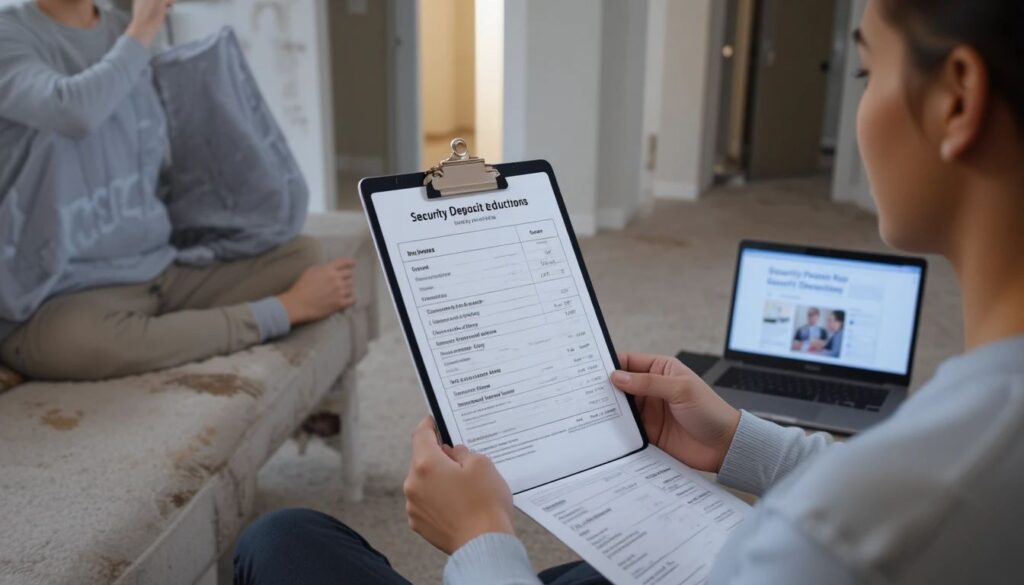
For official rental guidance, the U.S. Department of Housing and Urban Development (HUD) provides helpful tenant information.
What Can a Landlord Legally Deduct From a Security Deposit:-
Landlords cannot keep a security deposit without reason. The law only allows deductions for specific costs directly caused by the tenant.
Common legal deductions include:
- Unpaid rent or outstanding utility bills.
- Damage beyond normal wear and tear.
- Cleaning costs if the unit is left excessively dirty.
- Removal of abandoned belongings.
- Lease violations that caused financial loss.
Normal wear and tear cannot be charged. This includes faded paint, minor scratches, or worn carpets from regular use.
The key rule is simple ie. landlords can only restore the property to its original condition, not upgrade it using your deposit.
Important fact: Security deposit deductions are limited to unpaid rent, damage beyond normal wear, and documented repair costs.
Landlord Not Responding About Security Deposit:-
One of the most frustrating issues tenants face is when the landlord does not respond after move-out.
What the law says:
Most states require landlords to return the deposit within 14 to 60 days after you move out.
If they fail to respond:
- They may be violating tenant laws.
- They must still provide an itemized list if deductions were made.
- Silence does NOT give them the right to keep your money.
What you should do:
- Send a written demand (email or letter).
- Request itemized deductions with proof.
- Keep all communication records.
- If ignored, escalate legally through small claims court.
Important fact: A landlord who misses the legal deadline may face penalties or be required to return the full deposit.
Landlord Refusing to Return Deposit Even With No Damage:-
This is one of the most common disputes ie. tenants leave the property in good condition, yet the landlord still refuses to return the deposit.
Common landlord excuses include:
- Cleaning fee.
- General maintenance.
- We always keep part of the deposit.
- Fake or exaggerated repair claims.
What the law says:
If there is no unpaid rent or damage:
- The deposit must be fully returned.
- The landlord must prove any deduction with evidence.
- Pre-existing issues or normal wear cannot be charged.
Tenant protection:
Tenants can dispute this in small claims court and often win if they have:
- Move-in photos.
- Move-out photos.
- Written inspection records.
In many cases, tenants successfully recover wrongfully withheld deposits through legal action.
How To Fight Unfair Security Deposit Charges:-
If a landlord deducts money unfairly, tenants are not powerless.
Step by step process:-
- Request itemized statement: Ask for a breakdown of all deductions with receipts and proof.
- Compare with move-in condition: Only damage caused during your tenancy is your responsibility.
- Dispute in writing: Clearly state which charges are incorrect and why.
- Send legal notice if needed: Remind landlord of state deadlines and tenant laws.
- File small claims case: If the landlord refuses to cooperate, court is often the final solution.
Strong evidence increases success:
- Move-in checklist.
- Photos/videos.
- Repair receipts (if you fixed anything yourself).
- Written communication with landlord.
Example: Tenants often win disputes when landlords charge for normal wear or pre-existing damage.
What Happens When Landlords Make Illegal Deductions?
If a landlord wrongfully keeps your deposit:
- You can recover the full amount.
- You may also get additional penalties in some states.
- Courts often side with tenants when documentation is strong.
In many cases, landlords lose disputes when they:
- Do not provide receipts.
- Charge for normal wear and tear.
- Try to deduct for improvements or unrelated damage.
How To Protect Your Security Deposit From The Start:-
Prevention is always easier than dispute.
Before moving in:-
- Take timestamped photos of every room.
- Document existing damage in writing.
During tenancy:-
- Report issues immediately.
- Keep communication records.
Before moving out:-
- Clean thoroughly.
- Fix minor damage if reasonable.
- Request a walkthrough inspection.
Good documentation is the strongest protection against unfair deductions.
If you want to avoid deductions and increase your chances of getting your full security deposit back, you can also follow this detailed guide: Move Out Checklist To Get Full Deposit Back.
Final Thoughts:-
Security deposit disputes usually come down to one thing ie. evidence and legal limits.
Landlords are not allowed to:
- Keep deposits without reason.
- Ignore return deadlines.
- Charge for normal wear and tear.
- Deduct without proof.
Tenants, on the other hand, can protect themselves by documenting everything and knowing their rights under state laws. In most cases, disputes are winnable when handled calmly and with proper records.